
Transport in Laos: A Backpacker’s Guide to Getting Around (Our Route + Booking Tips)
When planning our Southeast Asia adventure, Laos topped our list of must-visit destinations. After 30 incredible days there, we couldn’t wait to share our experiences – and insights – with you.
Laos is incredible, but transport is notoriously confusing, slow, and sometimes frustrating.
That’s why we put together this detailed guide – for travelers like us who want to explore every corner of Laos without unnecessary stress.
👉 Keep reading for budget-friendly tips on traveling Laos by bus, boat, train, and flight – plus our first-hand stories from crossing the country north to south.
DISCLOSURE: This post may contain affiliate links, which means we may earn a small commission if you book or buy something through them – at no extra cost to you. We only recommend things we’d actually use ourselves. Read more in our Privacy Policy.
Overview of Transport in Laos
Buses & Minivans
This is the most common mode of transport in Laos and more often than not it will be a public service.
When you take public transport in Laos, expect it to be a long, windy road, fitting more people (and bags of produce) into a minivan than you could ever imagine.
There were a number of occasions where we bought our bus ticket through our guesthouse and expected this to be a shared minivan situation but 9 times out of 10 it was just another public bus.
Since the buses and minivans are super cramped, you might be wondering where your luggage goes? Don’t put anything fragile into your main backpack as it will be tied to the roof of the bus.
TOP TIP: Don’t bother booking VIP tickets in Laos. It is not the same as VIP in countries such as Thailand or Vietnam.

Boats & Slow Boats
The most popular boat route in Laos is the slow boat from Huay Xai to Luang Prabang. We did not fancy spending two days with a numb bum so traveled around Northern Laos instead.
If you do fancy a taste of a long-distance long boat trip, read about the one we took in Northern Thailand on the way to Huay Xai.
Aside from the slow boat in Laos there aren’t too many times you’ll be taking a boat – makes sense since Laos is a land-locked country.
On the rare occasion you do (Nong Khiaw-Muang Ngoi or Nakasong-Don Det) the boat will be a traditional long boat like the ones you see in South Thailand.
Trains
We went full nerd-mode over the trains in Laos.
The Laos-China rail (LCR) network is always expanding throughout Laos so treat yourself to a comfortable high speed train between popular destinations like Luang Prabang, Vang Vieng and Vientiane.
Railway links are a little stricter with what you can carry in your luggage. The most common rule is to make sure your aerosols are less than 120ml. Vapes and sharp objects are also prohibited.
TOP TIP: Foreigners can’t buy train tickets online directly. You can purchase from ticket agents in town or via 12Go. The agent you purchase through will either send you your ticket or hand-deliver them to your guesthouse.
Songthaews & Tuk-Tuks
A songthaew is a pick up truck converted into a taxi. There are 2 or 3 wooden panels to sit on, and tend to have a cover built in to protect from the elements. Think of it as Laos’s answer to tuk tuks.

You will probably travel in a songthaew when going from your accommodation to the transit hub (e.g. bus station or train station). When you arrive at your destination songthaews are usually waiting to take you to your guesthouse.
The only time we were on a songthaew for an extended period was during our journey from Kong Lor Village to Thakhek. But that’s a whole other story!!
Flights & Airports in Laos
There are multiple airports in Laos that you’ll be able to reach from anywhere in the world – just don’t expect any direct flights unless you’re already in Asia!
The main airport is located in Vientiane, the country’s capital, but there are other options as well:
International Airports in Laos
- Vientiane (VTE)
- Luang Prabang (LPQ)
Popular Domestic Airports in Laos
- Pakse (PKZ)
- Luang Namtha (LXG)
- Oudomsay (ODY)
Getting Into Laos
Both local and international transit options are available to major cities in Laos.
From Thailand
The route most traveled is from Chiang Rai in Thailand’s North to Huay Xai, the border town in Laos. This route is well-developed and efficient.

Steps to cross the border include:
- Bus to the Friendship Bridge from the bus station in Chiang Rai
- Pass through Thai Immigration
- Bus across the Thailand-Laos Friendship Bridge
- Pass through Laos Immigration
- Songthaew into Huay Xai town
✅ For a comprehensive guide on what to expect from the Thai-Laos border crossing read our detailed how-to guide.
From Vietnam
Travel between Laos and Vietnam is not super common, but definitely possible! There is a 22 hour sleeper bus from Da Nang to Vientiane that is well-rated.
Don’t expect luxury on this route (or anywhere in Laos, really), but it will get you to Laos in one piece.
🚍 Heading to Vietnam? Read our top tips on taking overnight sleeper buses
From Cambodia
There is a highly reputable company, based in Cambodia, called Asia Van Transfer (AVT).
We used them for the reverse trip from Don Det to Siem Reap and it was an effortless experience. Having checked reviews, other travelers rave about the Siem Reap to Don Det route as well.
The best part about using AVT is the ease of the whole border crossing. Prior to departure we were given clear instructions of what to expect from start to finish and everything went according to plan.
The route consists of the following checkpoints:
- Siem Reap to Stung Treng – here you’ll be able to find an ATM in case you need it
- Stung Treng to Cambodia Immigration
- Cambodia Immigration to Laos Immigration – this is a 300 meter walk
- From here you will be taken to either Pakse or Don Det, depending on your plans
How to Travel Between Major Destinations
If you’re backpacking Laos, chances are you’ll spend a lot of time on buses. They’re the most common (and cheapest) way to get between destinations – though not always the fastest or most comfortable.
Some stretches can be swapped for a minivan, train, or even a flight if you’re short on time.
Here’s how we made our way through Laos, plus the alternative routes you can take depending on your style of travel.
North Laos (Huay Xai, Luang Namtha, Nong Khiaw, Luang Prabang)
Huay Xai to Luang Namtha (Bus & Minivan Options)
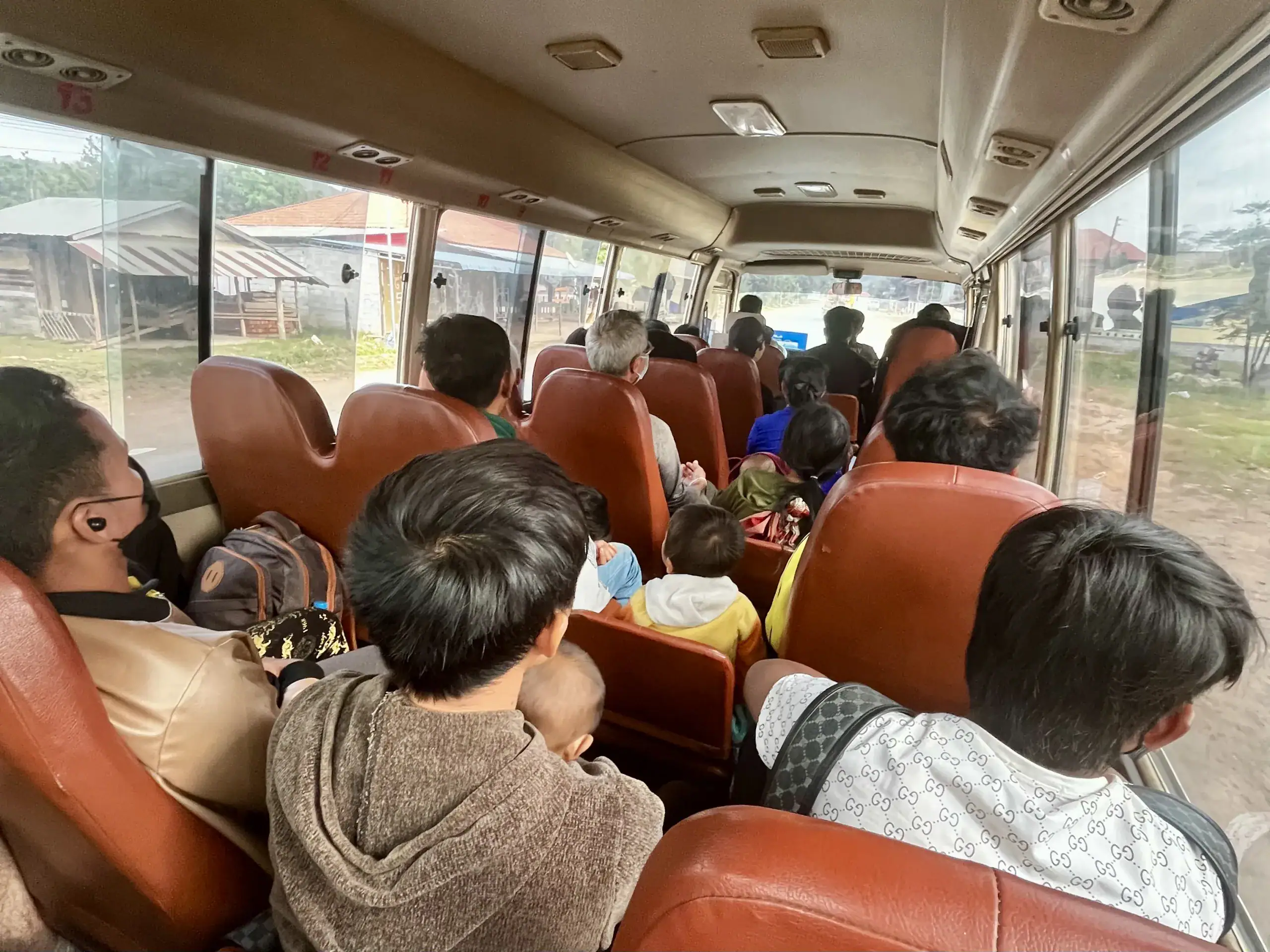
After journeying from Northern Thailand, Huay Xai will be your first taste of Laos. There are lots of guesthouses and a few hostels that you are able to book on arrival.
Your accommodation will help you to book your onward journey, whether that be North to Luang Namtha, or somewhere else in the South.
For us, this was a great taste of what to expect from Laotian transport in general.
A songthaew picked us up from our hostel, drove us to the bus station, bought our ticket to Luang Namtha for us, then guided us to our bus.
TOP TIP: Throughout this process, it may feel like you don’t know what’s going on. This is a regular theme throughout Laos. It’s important to get comfortable with the lack of control, and trust the people and the process.
Huay Xai to Luang Prabang (Alternative Route)
Perhaps trekking isn’t for you, or you don’t have the time to stay in Luang Namtha. If so, you can head straight to Luang Prabang like most travelers do. There are buses that depart in the morning, afternoon and evening.
The most popular route into Laos is the 2-day slow boat from Huay Xai to Luang Prabang. Backpackers on a budget tend to opt for the public slow boat as a right of passage.
👉 Use our itinerary once you arrive in Luang Prabang.
Personally, we can’t think of anything worse than 2 days sitting on a wooden bench, crammed in like sardines (hot take, we know).
Should your budget allow, there are many tour options available to conquer this journey.
For the extra money, expect much more comfort, fewer people, and better hospitality. Many tours will start in Chiang Rai and include assistance at the Thai-Laos border.
Luang Namtha to Nong Khiaw (Our Route by Bus)
Prepare yourself for a bumpy journey along 6 hours of windy roads in a minivan.
We won’t lie, this is not a pleasant journey. Still, it was well worth it to go directly to Nong Khiaw after a few days exploring Northern Laos.
For ease, we advise booking through your guesthouse or a tour company in Luang Namtha. More often than not, doing this ensures you have a songthaew to the bus station included in your ticket price too.
Luang Namtha to Luang Prabang (Alternative Connection)
If you’re not sold on a visit to Nong Khiaw just yet, you can take the 310 km bus trip south to Luang Prabang that departs daily from Luang Namtha.
This is a long travel day – have a look at things to do in Nong Khiaw to tempt you into breaking up the journey.

Instead of a bus, we recommend taking advantage of the expanding Laos-China rail (LCR) network and take the train from Nateuy Railway Station to Luang Prabang.
This is much quicker and more comfortable than the bus. The only downside is that you will need to get to Nateuy Railway Station which is about 30 km from Luang Namtha town.
Ask your accommodation to help you book this route as you cannot book online.
Nong Khiaw to Luang Prabang (Local Bus & Minivan Options)
Multiple buses run throughout the day from Nong Khiaw to Luang Prabang.
Buses travel to both the North and South bus stations in Luang Prabang. The price difference is minimal and they’re both a similar distance from the center of Luang Prabang.
Therefore, don’t worry about not getting on a bus as we got the sense that they run more minivans to both the North and South stations until all travelers are on board and Luang Prabang bound.
Luang Prabang to Nong Khiaw (Round Trip Option)
After speaking with many backpackers, the most popular route seems to be a return trip to Nong Khiaw from Luang Prabang.
As of February 2024, the bus leaves at 9am daily from Luang Prabang, only taking 3 hours. You can find details of the return leg (Nong Khiaw to Luang Prabang) above.
Central Laos (Luang Prabang, Vang Vieng, Vientiane, Kong Lor)
Luang Prabang to Vang Vieng (Bus, Minivan & Train Options)
Another popular route on many Laos itineraries, there are a number of transport options running from Luang Prabang to Vang Vieng.
Vang Vieng takes 7 hours to reach by bus, but we strongly recommend against taking the bus.
For only a few dollars more, you can take the high speed train and be in Vang Vieng within an hour. The choice is yours, but don’t make the wrong one.
🌄 Looking for somewhere to stay in Vang Vieng? These are our top hotel and hostel recs with the best views for every budget.
TOP TIP: Check for national holidays when you need to take popular transport links. We made this mistake and had to take the bus to Vang Vieng over Chinese New Year as the train had already sold out days before. Learn from our mistakes!
Vang Vieng to Vientiane (Express Train vs Bus)
Another well connected route means another no brainer as to which transport mode to take. The bus takes around 6 hours or the fast train takes 52 minutes precisely!
Please be aware though, that the Lao-China railway links are a little stricter luggage wise than the buses. By this we aren’t referring to luggage size, more so what is contained within your luggage.
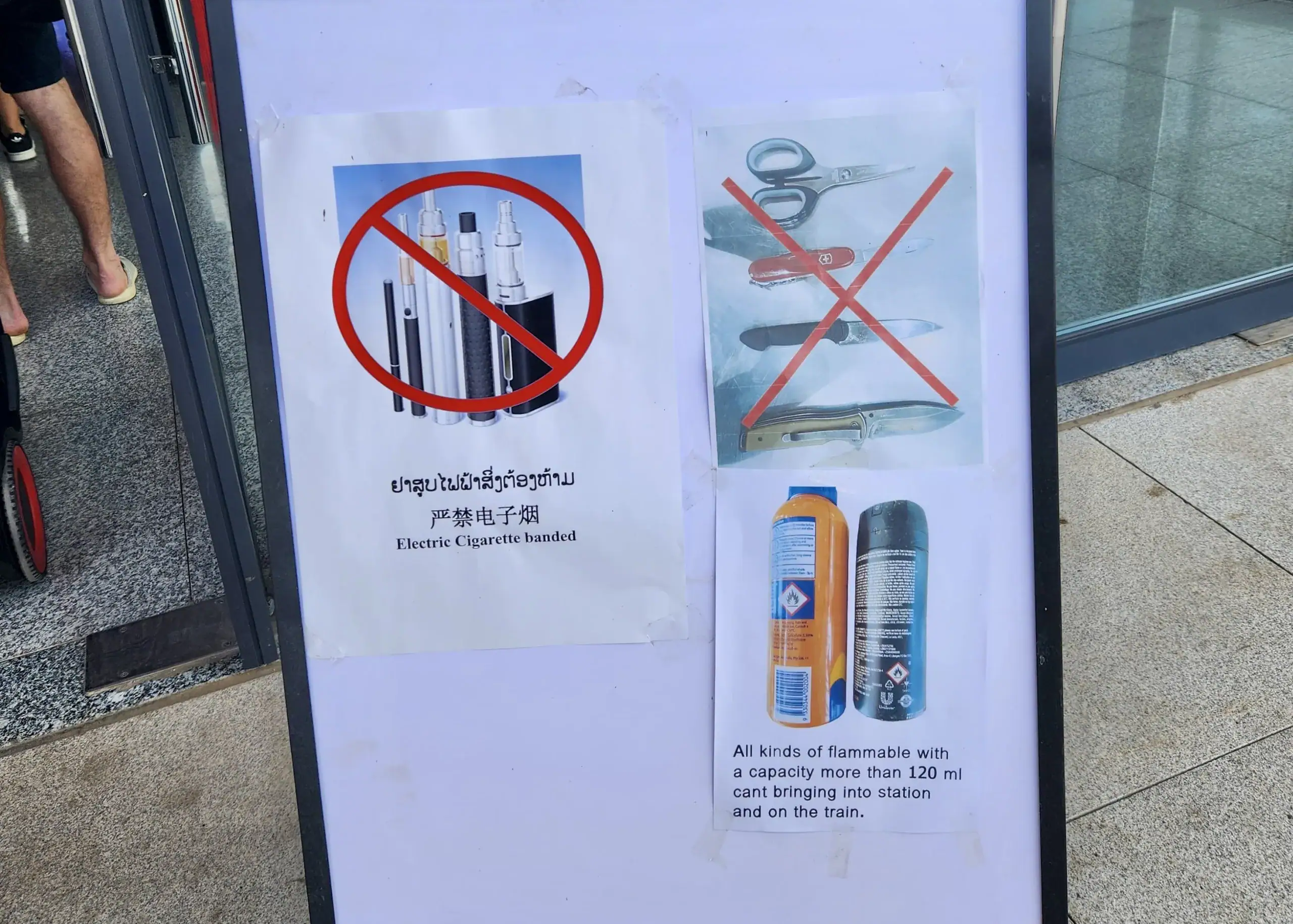
Check online before traveling for latest updates, but in early 2024, you cannot carry vapes (illegal in Laos), sharp objects, or anything flammable (e.g. aerosols) with a capacity of more than 120ml.
Vientiane to Kong Lor (Bus & Minivan Options)
This 10 hour commute is one few travelers take. Many choose to go to Thakhek for the motorbike loop.
If, like us, you only want to see the main attraction of the loop – Kong Lor Cave – then you can take a bus from the Southern Bus Station in Vientiane.
🌄 Heading to Kong Lor Cave? Our guide covers how to get there (and how to leave!!) + details of the cave tour.
Vientiane to Pakse (Alternative Long-Distance Routes)
Surprisingly, we didn’t actually take any sleeper buses in Laos. Friends we met along the way told us they were comfortable, with a similar set up to the sleeper buses in Vietnam.
The only difference being, VIP is not a thing in Laos. In most cases there is one sleeper bus a day and from time to time you may see the aisles are filled with people too.
The sleeper bus from Vientiane to Pakse takes 13 hours.
TOP TIP: Book two seats if you are traveling solo if you don’t want to share a small bed with a stranger. This way you will have more room and hopefully get some sleep!
South Laos (Pakse, 4000 Islands)
Kong Lor to Pakse (Bus Connections)

Strap in for a travel day to remember! The day starts with a 5 hour public songthaew to Thakhek.
Many people choose to stay in Thakhek at this point to break up a long travel day. If the songthaew from Kong Lor arrives in time, you could also get the bus straight to Pakse.
The daily local bus from Thakhek to Pakse departs between 9am and 11am each day depending on when the bus is full. Alternatively there is a minivan via Savannakhet to Pakse or a night bus that operates every hour from 7pm.
We would recommend asking at the information desk in the bus station for more details about the next departure to Pakse.
🏍 Heading to Pakse for the Bolaven Loop? Read our 3-day motorbike itinerary + our advice to help your visit run smoothly.
Pakse to Don Det & the 4000 Islands (Minivan & Boat)
By Laos standards this bus and boat journey is pretty painless. There are lots of booking agents around Pakse town for you to book your trip.
We recommend booking with Miss Noy (the same place we hired a motorbike for the Bolaven Loop).
You can also book the bus and boat tickets through your guesthouse in Pakse if you’re staying there on your trip to Laos.
Motorbikes in Laos
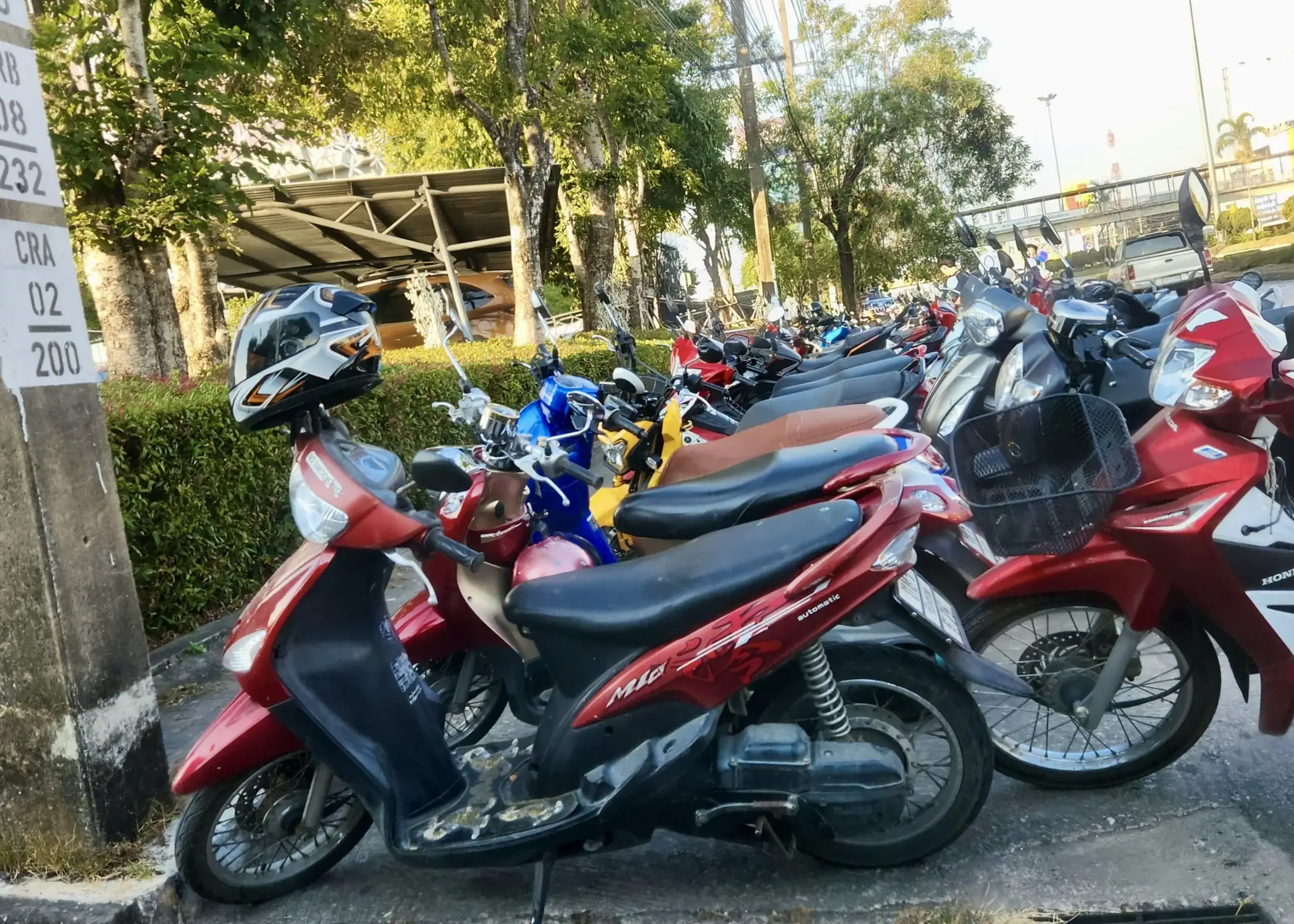
Motorbike Safety
We can promise you that we are not exaggerating here. At every place we visited in Laos, we saw tourists bandaged up as a result of motorbike accidents.
When we say we saw at least 5 foreigners per destination sporting a bunch of cuts and bruises, we are not joking.
Without sounding too cynical, it seems to be a trend that people hire motorbikes throughout Laos despite having no prior experience riding one.
This is kind of insane – we are sure it wouldn’t even be considered in their home country. The roads in Laos are extreme and unpredictable. We covered the length of the country and can vouch for this.
Hazards range from giant potholes, unpredictable animals, reckless truck drivers, and spontaneous construction that make roads almost impassable.
This is the very reason we were so hesitant to hire a motorbike in Pakse.
We had done so previously in Thailand so only chose to hire one for the Bolaven Loop after extensive research on the improved road safety in comparison to the North of Laos.
We may sound overly cautious, but we saw too many injured parties for this not to be taken seriously.
If you don’t have a motorbike license, your travel insurance won’t cover you for accidents should the worst happen. Check the small print of your travel insurance to see if you would be covered in the event of an accident.
👉 We use Safety Wing insurance and we have no complaints! 👈
Things to Consider before Hiring a Motorbike
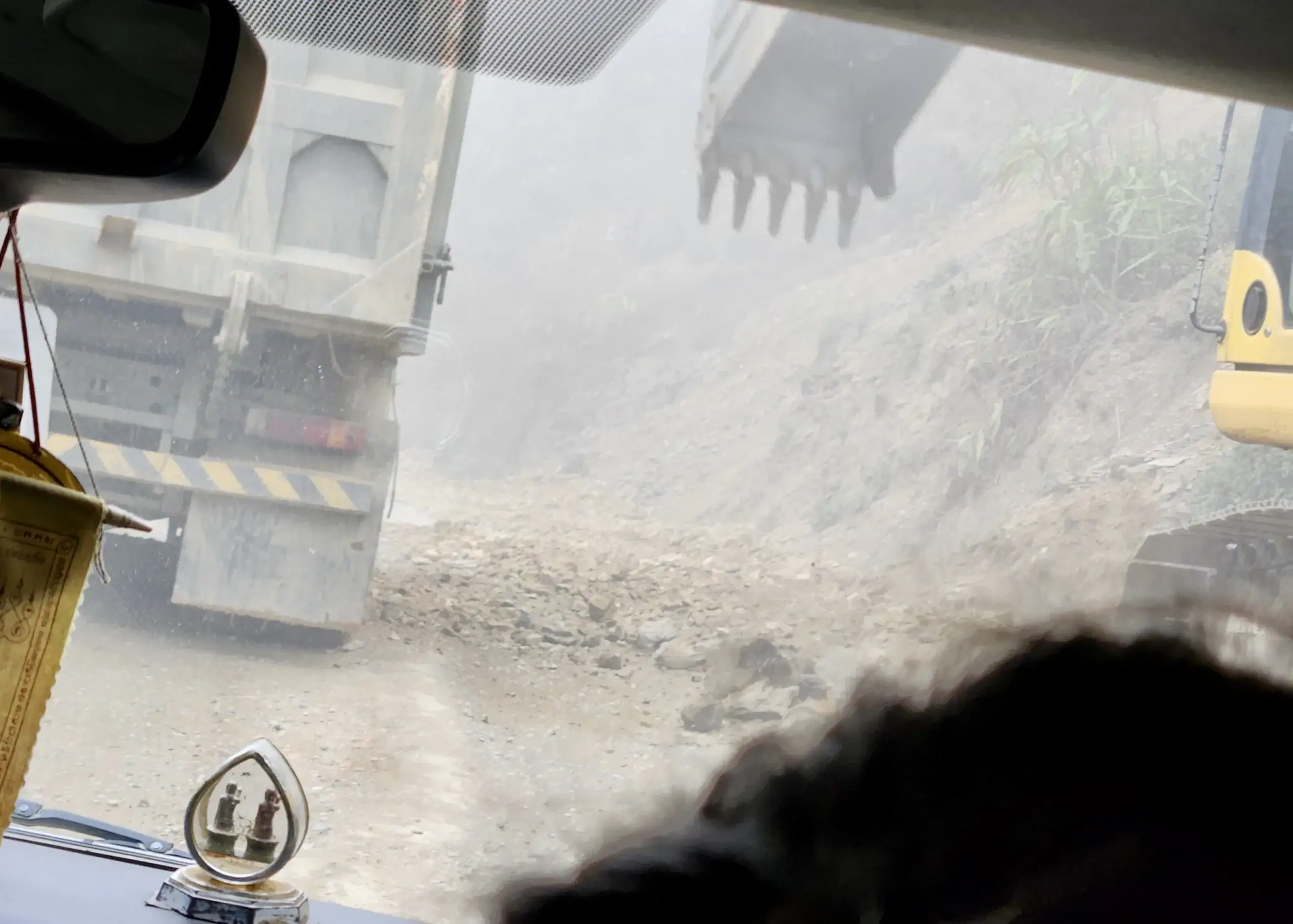
If, after careful consideration, you would like to hire a motorbike for some or all of your Laos adventure, here are some things to know:
- Check Google Maps for reviews of hire companies to avoid scams.
- Unless you have done your research and believe you are hiring from a reputable company, do not hand over your passport as insurance. Instead offer a cash deposit. You don’t want to be left in a position where your passport is held hostage for damages to the bike you may not have caused.
- Weigh up your options – time, money, and experience wise. Wherever possible stick to public transport. You are much safer in a bumpy bus driven by a local than you are at the wheel yourself.
🏍 If you’d like more advice on hiring a motorbike in Laos, read our extensive guide here.
FAQs About Transport in Laos
What is the cheapest way to travel around Laos?
The cheapest way to travel around Laos is by bus. All modes of transport are cheap in comparison to Western prices.
However, transit in Laos is expensive relative to the cost of everything else (food, beer, accommodation, etc.).
Is there Uber or Grab in Laos?
Uber and Grab are not available in Laos.
However you can use Loca, Laos’s own ride-hailing taxi app. It is available in Vientiane, Luang Prabang, Vang Vieng, Pakse and Savannakhet.
How do I book transport in Laos?
It is possible to book transport in Laos on 12Go. Our advice would be to check here first to gauge what price you should pay, then check with your accommodation.
When you book through your guesthouse, they usually arrange for a songthaew to take you from the guesthouse to the station.
If you are not a resident of Laos, you cannot book train tickets online. Websites such as 12Go can book train tickets for you, or you can book in person through an agent in town.
You can also purchase directly from the train station from 2 days before the departure date.
Should I book tickets in advance?
You will be able to show up to a bus station and jump on a bus. Our advice would be to book the day before, just to ensure you have a ticket as some routes can be very busy.
As for train tickets, try to book a few days in advance if possible.
What to Expect from Transport in Laos
Traveling around Laos can be frustrating at times – buses are crowded and air conditioning is more of a luxury than a guarantee. But that’s also part of the adventure.
👉 Our best advice: go in with low expectations and a flexible mindset. If you’re ready for delays, bumps, and a little discomfort, you’ll find the journey much easier to enjoy.

Laos isn’t about sleek infrastructure; it’s about slowing down, embracing the unexpected, and connecting with the people. We learned quickly that when you trust the process – and the Laotian people, who genuinely want you to love their country – every bumpy ride feels worthwhile.
Yes, the transport can test your patience. But it’s also what makes Laos so memorable. We’d happily take another long, sweaty bus ride if it meant discovering one more mountain village or river bend along the way.
For budget backpackers and first-time visitors, this mindset shift makes all the difference: plan loosely, expect delays, and you’ll leave Laos with incredible stories, not frustrations.
👉 If you’re a first-time visitor, don’t worry – we’ve broken down exactly how to handle the trickiest routes. Check out our detailed guides to crossing the Thailand–Laos border and traveling from Don Det to Siem Reap.
